


The Unseen Edge: Why Pro Cyclists Are Rethinking How They Breathe
Watts, aerodynamics, nutrition timing. Cyclists optimise everything. But there's one system most riders ignore for the entire race: their breathing. Here's what peer-reviewed research actually says about nasal breathing on the bike, and where a small adhesive strip genuinely fits in.
Modern cycling is an obsession with marginal gains. Tyre pressure to the decimal. Power-to-weight calculations. Bike fit sessions that last longer than the rides themselves. Yet most riders never think about the system that runs continuously from minute one of a stage to the last kilometre: their respiratory function.
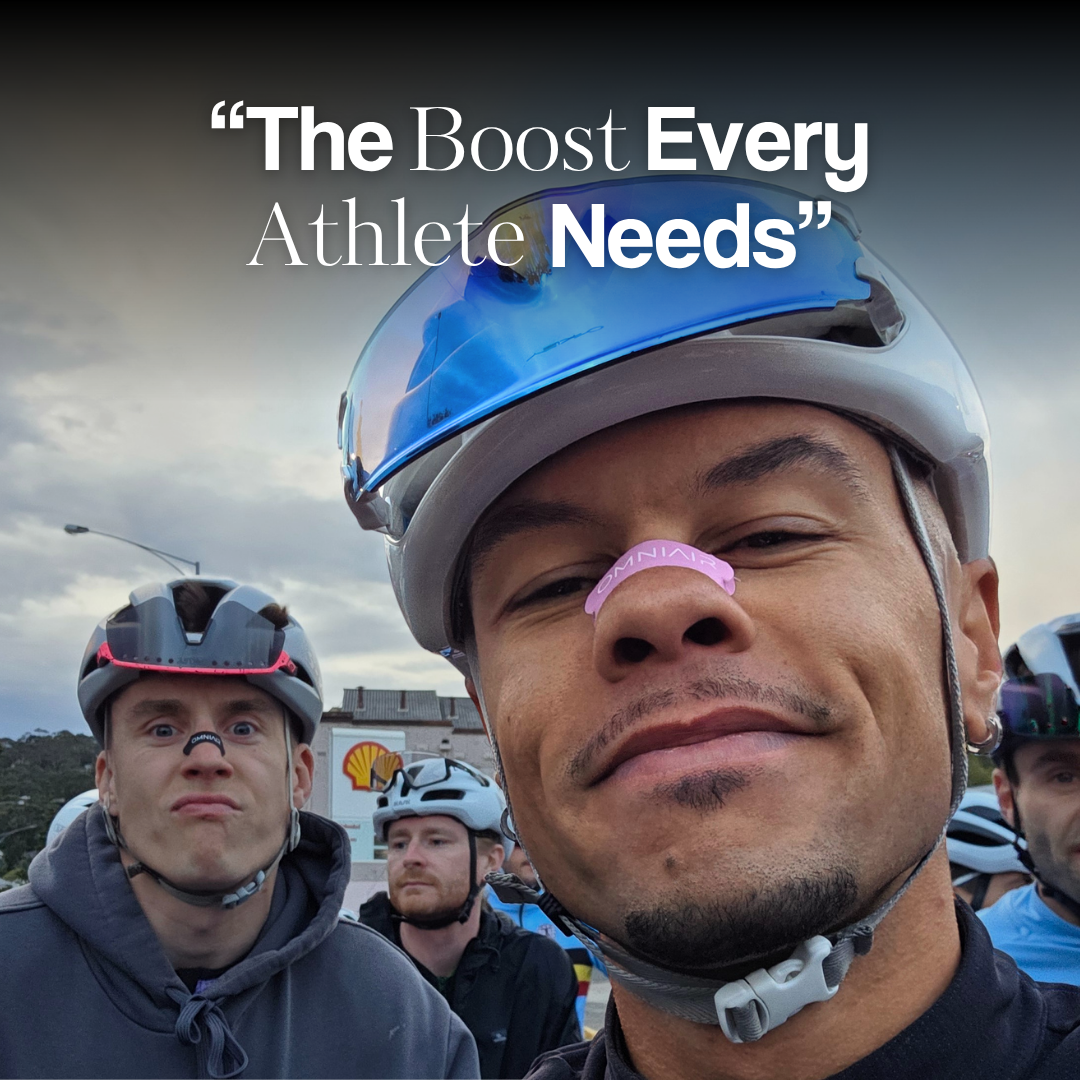
That's slowly changing. Over the last two seasons, nasal strips have started appearing on the faces of WorldTour riders. Not as a trend, but as a deliberate piece of equipment. The question this blog answers: does the science actually support nasal breathing optimisation for cyclists, or is it just another piece of marketing-driven kit?
This is the honest version. What the research says. Where it stops. And where a tool like OMNIAIR genuinely fits into a cyclist's performance architecture.
The breathing bottleneck nobody talks about
Cycling is one of the most respiratory-demanding endurance sports on earth. A grand tour stage can deliver 4 to 6 hours of sustained submaximal output, with repeated efforts above threshold during climbs, attacks, and sprints. That's hours of high ventilation under physical stress.
What most riders don't realise: the nose, not the lungs, is often the limiting factor. Roughly 50 to 60% of total airway resistance sits in a small zone called the nasal valve, just inside the nostrils. A clinical study by Roithmann and colleagues in The Laryngoscope demonstrated this using acoustic rhinometry: the nasal valve is the single highest-resistance point in the entire airway.
When you ride hard, or get even slightly congested from pollen, dust, or cold air, the soft tissues around that valve collapse inward. Your body defaults to mouth breathing earlier than it needs to. Hours of mouth breathing means drier airways, faster respiratory muscle fatigue, and a sympathetic-dominant nervous system state that taxes everything from heart rate to perceived effort.
What the research actually shows
Forget the marketing claims. "40% more airflow" doesn't appear in any peer-reviewed study. Here's what the actual science shows.
Roithmann's clinical study measured exactly what an external nasal strip does: it significantly increases the minimum cross-sectional area of the nasal valve and reduces airflow resistance. A 2000 study by Kirkness and colleagues in the European Respiratory Journal confirmed the mechanism: the springy bands stabilise the lateral nasal walls so they don't collapse during forceful inhalation.
For endurance intensities specifically, a 2017 study by LaComb and colleagues tested trained athletes at 50%, 65%, and 80% of VO2max. At 65% and 80% (the zones most cyclists race in), nasal breathing was significantly more efficient than oral breathing. Same oxygen delivery, less respiratory work. A 2018 study by Dallam and colleagues found similar results: at submaximal intensity, nasal breathing matched oral breathing on VO2max output while improving ventilatory efficiency.
A more recent 2025 Frontiers in Physiology study specifically tested well-trained cyclists and triathletes. The finding: opening the nasal airway during combined nose-mouth breathing influences ventilatory efficiency in trained endurance athletes. Cyclists were literally the test population.
The nervous system effect
Beyond efficiency, nasal breathing has a measurable effect on the autonomic nervous system. A 2018 systematic review by Zaccaro and colleagues in Frontiers in Human Neuroscience concluded that slow, controlled nasal breathing activates the parasympathetic nervous system, increases heart rate variability, and lowers perceived stress.
For a cyclist, this matters most during the moments where rhythm and composure break down: the final 30 minutes of a long stage, a critical climb, a breakaway under threshold pressure. Hours of sympathetic-dominant breathing is metabolically expensive. Higher baseline heart rate. More stress hormone output. Cumulative fatigue that bleeds into the next day's stage.
A 2026 narrative review by Amirsadri and Sedighi in Behavioral Sciences synthesised 70 studies on nasal breathing and noted that nitric oxide produced in the sinuses, concentrations up to 30,000 parts per billion, improves pulmonary oxygenation by up to 18% in some studies. Mouth breathing skips this entire system. Multiply that small efficiency loss across a 5-hour stage and the cumulative cost is real.
Where the OMNIAIR strip actually fits in
So we've established three things. Nasal breathing is more efficient at submaximal cycling intensities. It has nervous system effects that compound over hours. And the nasal valve is the mechanical bottleneck that forces riders to mouth breathe earlier than necessary.
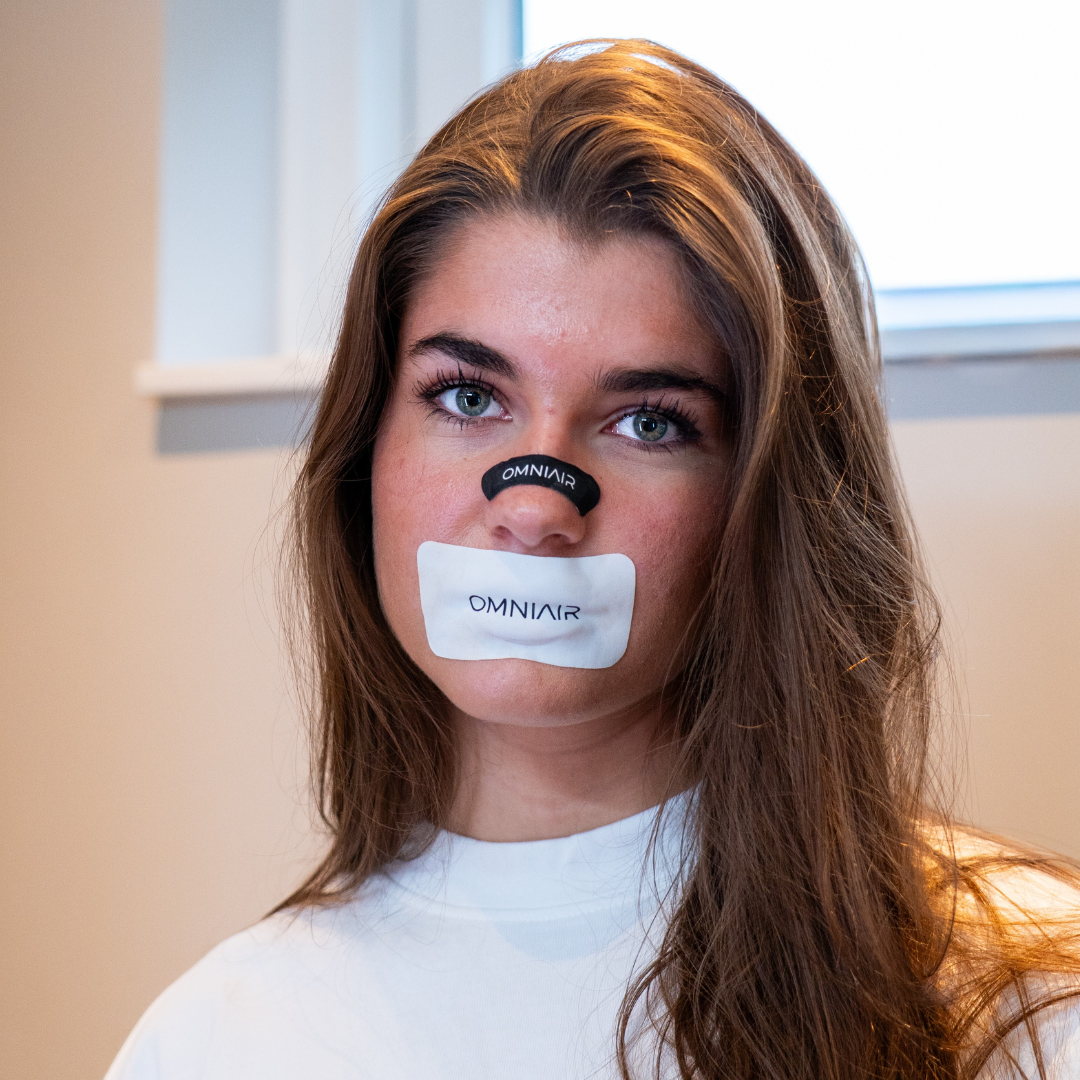
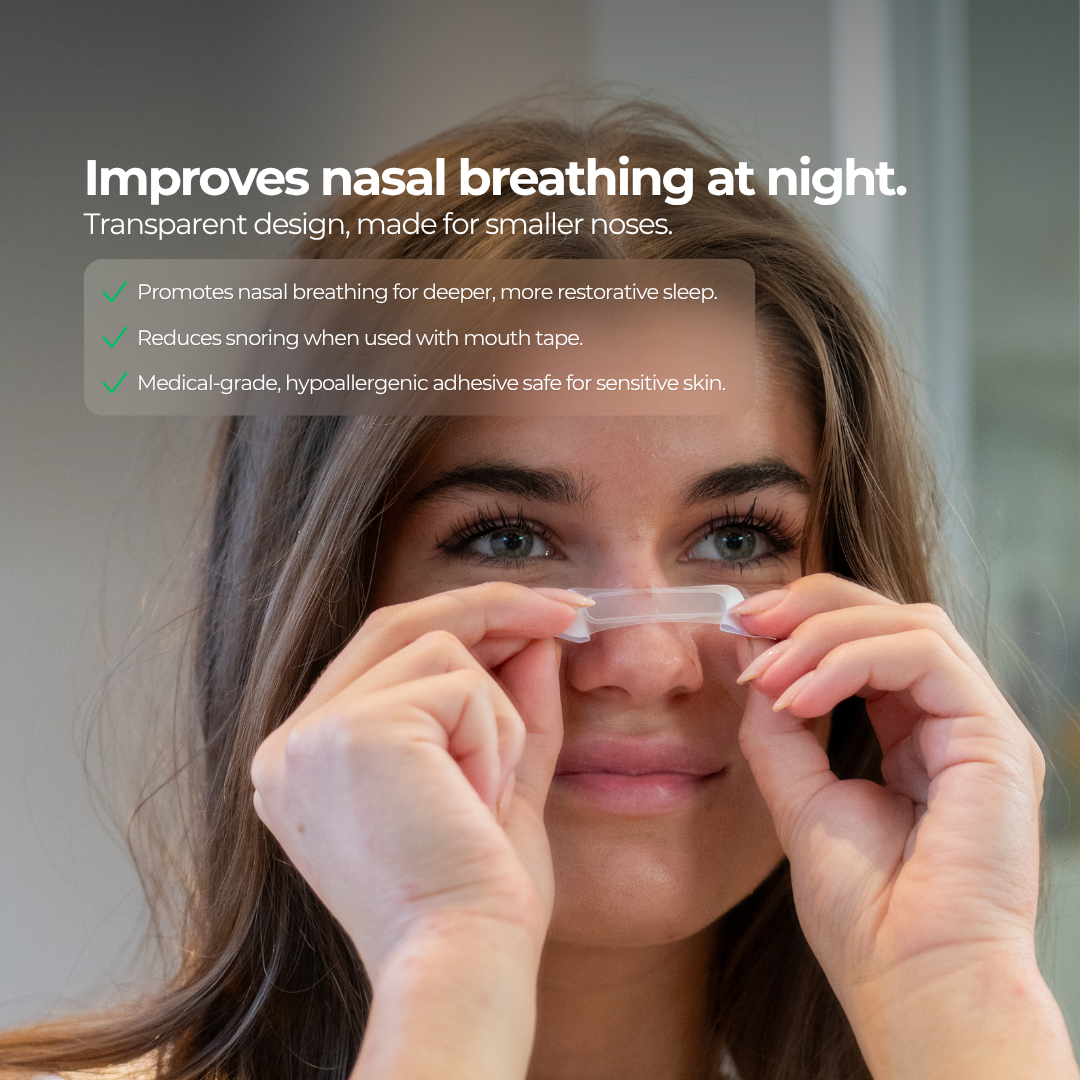
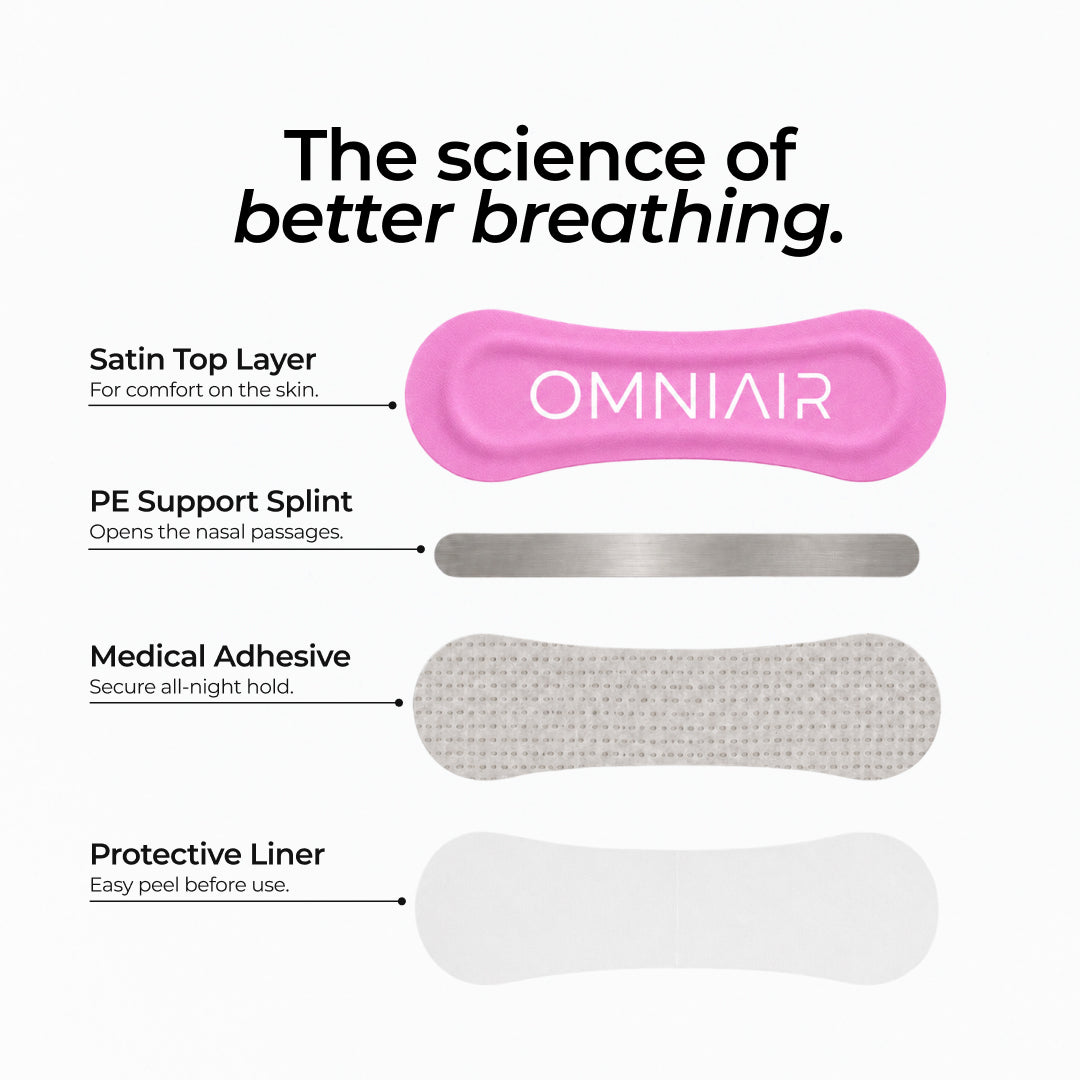
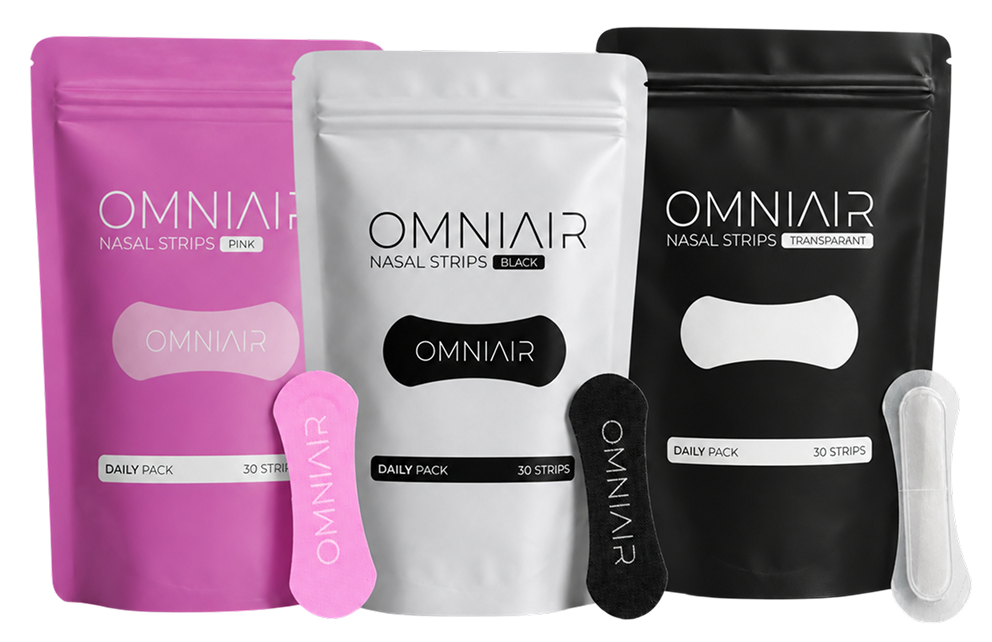
That's where a strip earns its place. It doesn't add anything to your physiology. It removes a mechanical barrier so you can use the nasal breathing you already have, for longer, under more cumulative load.
The practical effect for cyclists:
- Sustained rhythm. A smoother respiratory pattern during steady-state efforts. This is the zone where most stages are won or lost.
- Aerodynamic compatibility. Aero positions compress the chest and the neck is extended. A strip keeps the nasal airway open in exactly the position where it tends to narrow.
- Environmental relief. Pollen, dust, exhaust, cold air. All factors that constrict the nasal passage during outdoor racing. A strip provides mechanical buffer against these.
- Mental quietude. An unobstructed, steady airway supports a calmer cognitive state. Several elite riders describe nasal strips as a tool that helps them stay composed when the race gets chaotic.
What a nasal strip does not do
Be honest about what to expect.
A 2021 meta-analysis by Dinardi and colleagues concluded that external nasal dilators do not significantly improve VO2max in healthy subjects. That's true. Nasal strips don't raise your ceiling. They lower the cost of operating below it.
What that means practically:
- You won't gain raw watts from wearing one.
- It won't make you a faster sprinter.
- It won't compensate for poor training or bad fuelling.
- It works best when you've trained nasal breathing capacity over weeks of consistent rides, not as a race-day gimmick.
The value sits in submaximal efficiency, autonomic regulation, and mechanical reliability over long duration. That's the entire pitch. It's enough.
How to test it for cycling
Treat OMNIAIR like any other equipment trial: nothing new on race day. Test it during long endurance rides, ideally in the 6 to 8 weeks before a target event. Use it on a 3-hour Z2 ride. Use it on a threshold session with hard efforts. Pay attention to how your breathing pattern responds in the third hour, not the first.
Some riders notice an immediate difference in airflow comfort. Others feel the benefit emerge gradually as the ride goes long. A few feel nothing meaningful. The honest reality is that response varies by individual nasal anatomy and pre-existing nasal valve tendency to collapse.
One practical note for racing: apply the strip to clean, dry skin before sunscreen. Done correctly, an OMNIAIR strip is engineered to hold through multi-hour stages, sweat, and helmet straps. No mid-race re-application needed.
The OMNIAIR standard
OMNIAIR isn't a hack. It's a precision-built component for the cyclist who pays attention to controllable variables. Specifically engineered to:
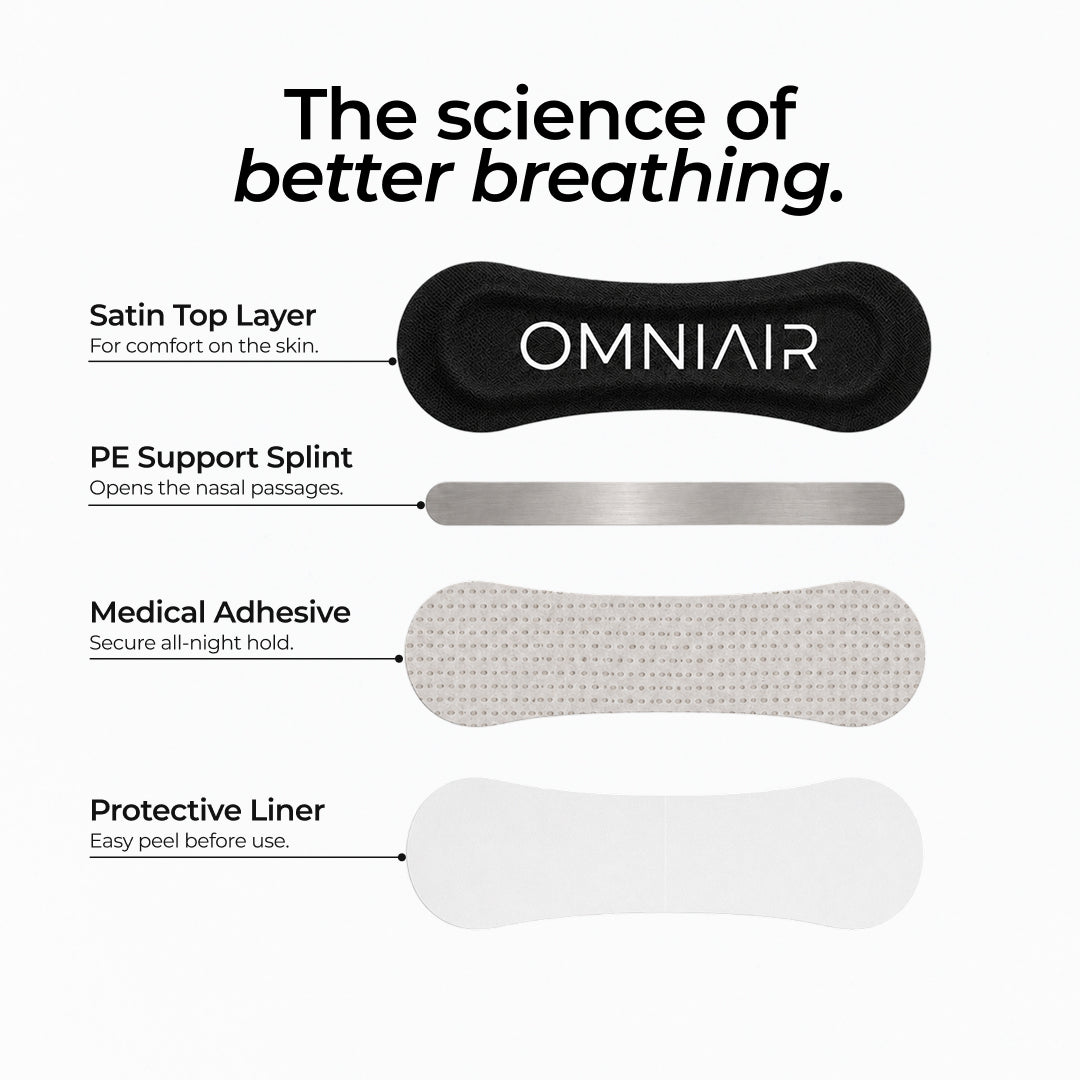
- Open the nasal valve without restricting the rest of the nasal passage
- Stay in place through sweat, helmet straps, and multi-hour stages
- Apply zero pressure on the bridge of the nose, which matters when you're wearing sunglasses for 5 hours
- Work compatibly with sunscreen and skincare
It's a small thing. But in a sport where the difference between podium and pack is measured in seconds and watts per kilogram, small things compound.
The unseen edge isn't a breakthrough technology. It's removing a small mechanical obstacle in the system that's been working the entire ride. Sometimes that's all the margin you need.
Sources
- Roithmann, R., et al. (1998). Effects of external nasal dilator strips on nasal patency: acoustic rhinometry measurements. The Laryngoscope. https://pubmed.ncbi.nlm.nih.gov/9628502/
- Kirkness, J.P., et al. (2000). Mechanical action of external nasal dilator strips on the upper airway. European Respiratory Journal, 15(5), 929-936. https://erj.ersjournals.com/content/15/5/929
- LaComb, C., et al. (2017). Oral versus Nasal Breathing during Moderate to High Intensity Submaximal Aerobic Exercise. International Journal of Kinesiology and Sports Science, 5(1). https://journals.aiac.org.au/index.php/IJKSS/article/view/3079
- Dallam, G.M., et al. (2018). Effect of Nasal Versus Oral Breathing on VO2max and Physiological Economy in Recreational Runners. International Journal of Kinesiology and Sports Science, 6(2), 22-29. https://journals.aiac.org.au/index.php/IJKSS/article/view/4400
- Frontiers in Physiology (2025). Effect of nasal decongestion during oronasal breathing in well-trained cyclists and triathletes. https://www.frontiersin.org/journals/physiology/articles/10.3389/fphys.2025.1654725/full
- Zaccaro, A., et al. (2018). How Breath-Control Can Change Your Life: A Systematic Review on Psycho-Physiological Correlates of Slow Breathing. Frontiers in Human Neuroscience, 12, 353. https://doi.org/10.3389/fnhum.2018.00353
- Amirsadri, A., & Sedighi, S. (2026). The physiological and psychological effects of nasal breathing: A narrative review of 70 studies. Behavioral Sciences. https://doi.org/10.3390/bs16030467
- Dinardi, R.R., et al. (2021). External nasal dilators do not improve maximal oxygen uptake during aerobic exercise: A systematic review and meta-analysis. https://pubmed.ncbi.nlm.nih.gov/34286410/

Ready to upgrade your recovery?
Science-backed tools, built for athletes who take recovery seriously.
Shop OMNIAIR